Why Key West Real Estate Is Unlike Anywhere Else in America
A Four-Mile Island at the End of the Continent
There is a moment that catches almost everyone who drives the Overseas Highway for the first time. You are 127 miles out from Miami, crossing bridges that seem to hover above open water, and the radio is fading between stations. Then the road straightens, the mangroves part, and Key West appears — a low silhouette of rooftops and palms resting at the edge of the sea, four miles long and two miles wide, the last piece of American land before Cuba.
What is less obvious, until you try to buy something here, is that this island operates under a set of real estate rules that exist nowhere else in the United States. The combination of geography, a unique growth-control ordinance, an architectural heritage protected by federal and local law, and a tourism economy that produces relentless demand creates a market that behaves less like a typical American housing market and more like a vintage commodity. There is a fixed supply. There is growing demand. And the mechanisms that normally allow supply to expand — new construction, subdivision, rezoning — have been deliberately, and largely permanently, restricted.
Understanding these forces is the difference between buying well in Key West and buying badly. It is also the reason long-term owners here have watched their properties appreciate at rates that surprise even experienced investors.
The Geography of Scarcity
Key West is an island of roughly seven square miles, surrounded on all sides by water, with no land left to develop outward. The highest natural point is Solares Hill, at 18 feet above sea level. There are no subdivisions waiting to be platted. There are no farms to convert. There are no hillsides to grade. Every buildable parcel that will ever exist already exists, and the island reached that threshold decades ago.
This distinguishes Key West from every other expensive American market. Manhattan is an island, but it grows upward. San Francisco is a peninsula, but its metropolitan area expands into the valley. Aspen is a valley, but its surrounding county holds room for development. Key West cannot grow in any direction. It cannot build taller, because height restrictions in the historic district and throughout most of the island are among the strictest in the nation. It cannot build outward, because the Atlantic Ocean and the Gulf of Mexico are on either side.
What this means in practical terms is that the housing stock is essentially fixed. New inventory comes almost entirely from resales, not from new construction. When a property hits the market, what you are looking at is a share of a finite total — and that total will not increase.
ROGO: The System That Saved Key West From Itself
In the 1970s, Key West faced a problem that nearly ruined it. Development pressure was intense, infrastructure was overwhelmed, and the island's character — the very thing that drew people — was being erased by generic condominium construction. In response, Monroe County and the City of Key West adopted something called the Residential Occupancy Growth Ordinance, known locally as ROGO.
ROGO is a rate-of-growth ordinance that allocates a limited number of residential building permits each year through a competitive point system. Applicants earn points based on criteria designed to favor affordable housing, infill development, and projects that serve the community's long-term interest. The number of permits available annually is small, and the waiting lists can stretch for years.
The effect of ROGO on the real estate market is profound. It does not merely slow growth; it effectively caps it. You cannot buy a vacant lot and simply build a house on it. You must compete for a permit allocation, and many property owners never receive one. This means that existing homes — homes that already have their permits, their infrastructure, their place on the grid — carry a structural premium that no market cycle can erode.
I have watched buyers from Miami, from New York, from California encounter ROGO for the first time and struggle to understand it, because nothing in their home markets prepares them for a system where the right to build is itself a scarce, rationed resource. But once they understand it, they understand the market. ROGO is the single most important factor in why Key West real estate holds its value over the long term.
Conch Architecture: Building for the Tropics Since the 1800s
The houses of Key West are not like houses anywhere else. The style that defines Old Town — the Conch house — developed through a fusion of Bahamian building traditions, New England shipwrighting skills, and practical responses to a tropical climate that were worked out over generations by people who lived here year-round.
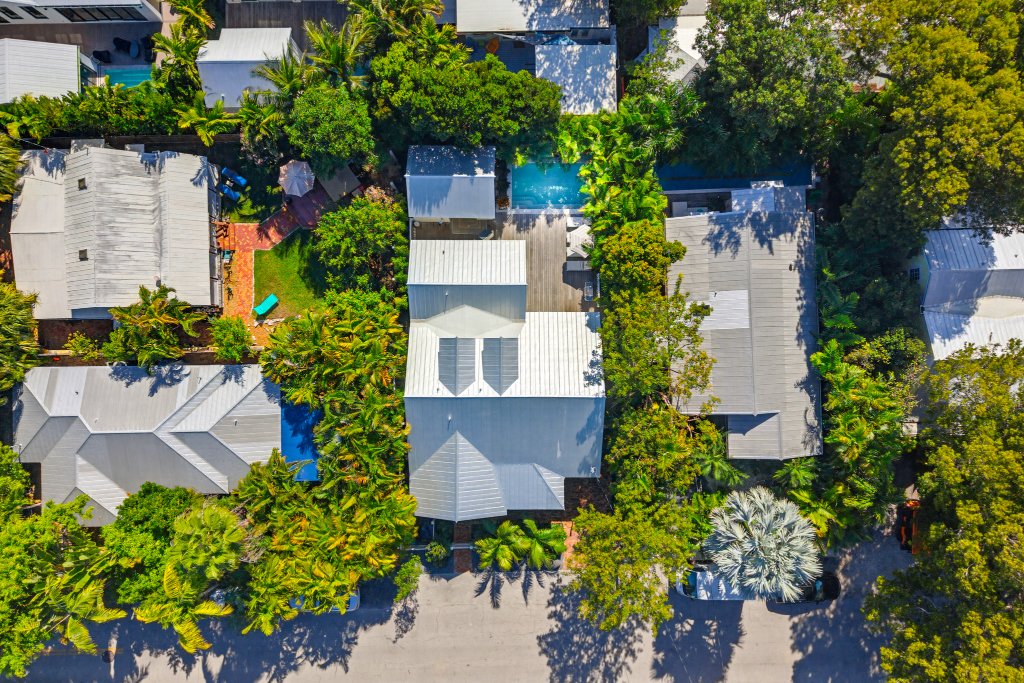
A classic Conch house sits close to the street, raised on piers to allow air circulation beneath the floor and to lift living quarters above flood risk. The footprint is often deep and narrow — the shotgun or conch shotgun form — which allowed cross-ventilation in the days before air conditioning. Wraparound porches, sometimes on two levels, shade the walls from direct sun. Louvered shutters, not decorative but functional, could be closed against storms while still allowing airflow. Roofs were originally of corrugated metal, painted white or in pale colors to reflect heat. The proportions are modest, the detailing is restrained, and the overall effect is architectural honesty — buildings designed to do a job in a specific place, without pretense.
This matters for real estate because these houses are not merely old. They are a distinct vernacular architecture that cannot be replicated today. The materials, the joinery, the proportions, the relationship to the street — all of it belongs to a specific era and a specific craft tradition. When you buy a well-preserved Conch house, you are buying something that has cultural value independent of its square footage or its lot size. And because the Historic District protects these structures from inappropriate alteration, that value is, in effect, insured.
The Historic District: A Living Museum With Plumbing
Roughly half of Key West lies within a locally and nationally designated historic district — one of the largest in the United States by number of contributing structures. More than 3,000 buildings contribute to the Key West Historic District, which is listed on the National Register of Historic Places and is also a locally regulated district overseen by the Historic Architectural Review Commission, known as HARC.
HARC reviews any proposed exterior change to a contributing structure within the district — additions, demolitions, new construction, paint colors, fencing, signage. The commission's standards are rigorous and specific, rooted in the Secretary of the Interior's Standards for Rehabilitation. The effect is that the visual character of Old Town is protected with a consistency that few American neighborhoods achieve.
For property owners, this cuts both ways. It means you cannot do whatever you want with your house. Renovations require approval. Certain changes — vinyl siding, inappropriate windows, modern railings on historic porches — will be denied. But it also means that your neighbor cannot do those things either, and that the streetscape that gives your property its value is protected from degradation. The historic district is, in real estate terms, a form of permanent quality control.
I advise clients who are considering a historic property to understand HARC not as an obstacle but as a partnership. The commission wants you to live in your house, update its systems, make it functional for the 21st century. What it asks is that you do so in a way that respects the building's character and its contribution to the street. Done well — and I have seen it done well hundreds of times — the result is a home that is both genuinely historic and genuinely livable, which is the most desirable combination this market offers.
Why Scarcity Here Is Different From Scarcity Elsewhere
Every desirable market has scarcity. What makes Key West different is the permanence of the constraint.
In most American cities, high prices eventually produce new supply. Developers buy land, builders construct homes, and the market rebalances. This is the mechanism that has moderated prices in city after city for a century. In Key West, that mechanism does not function. There is no land. There is no ROGO capacity. There is no ability to build upward. The only way supply increases is through the slow turnover of existing properties, and that turnover is determined by owners who, in many cases, have no urgency to sell.
The result is a market that is structurally supply-constrained in a way that almost no other American market is. When demand rises — and in Key West, demand rises every winter, as visitors from colder climates arrive and some fraction of them decide they want to own a piece of what they found — prices respond. When demand falls, as it did in 2008 and briefly in 2020, prices hold better than they do in markets with elastic supply, because owners are not competing with new construction. They are competing only with each other, and most of them can afford to wait.
This is why long-term Key West owners have experienced appreciation that consistently outpaces mainland Florida markets. The constraint is not cyclical. It is geographic and legal, which means it is permanent.
The Economics of an Island Market
Key West's economy is unusual for a town of 25,000 people. It hosts roughly three million visitors per year. It is a cruise ship port, a fishing destination, a literary and arts colony, a Navy installation, and a tourism hub of national significance. The demand for accommodation — hotel rooms, vacation rentals, second homes — is continuous and substantial.
This creates a real estate dynamic that supports property values from multiple directions. Primary residences are in demand from locals and relocating retirees. Second homes are in demand from affluent buyers across the country. Investment properties are in demand because short-term rental income on the island can be among the highest per square foot in Florida. The catch is that vacation rental licensing is itself restricted. Properties that wish to operate transient rentals of fewer than 28 days require a license, and the number of licenses is capped. The city uses a lottery system and a waiting list, and licenses are not guaranteed. I advise every investor client to understand the transient rental license situation before purchase, because it materially affects the income a property can generate and its long-term investment profile.
This layer of regulation — ROGO, HARC, rental licensing, flood zones, building codes calibrated for Category 5 hurricanes — is not a bug of the Key West market. It is the feature. Each restriction, taken individually, might seem like friction. Taken together, they form a framework that protects the island's character and, by extension, the value of every property on it.
What This Means for Buyers
If you are considering a purchase in Key West, understand that you are entering a market where patience is rewarded and impulse is punished. Good properties in good locations do not sit long, but they also do not appear every week. Working with someone who knows the inventory — including what is not officially listed — is the single greatest advantage you can give yourself.
Be clear about what you want. A historic Conch house in Old Town is a different investment and a different lifestyle than a newer home in a gated community on the golf course. Both can be excellent purchases. They are not interchangeable, and the right one depends on how you plan to use the property, how much renovation you are prepared to undertake, and what your long-term financial objectives are.
What This Means for Sellers
If you own property in Key West, you hold a scarce asset in a constrained market, and that gives you leverage. But leverage only translates to value if the property is presented, priced, and marketed with the sophistication the market expects. Key West buyers — particularly the affluent second-home and investment buyers who drive the upper tier — are experienced. They compare your property against everything they have seen, in Key West and elsewhere. They respond to authenticity, to genuine local expertise, and to properties that are honestly represented.
The mistake I see most often from sellers is underestimating the buyer's sophistication. The second mistake is overestimating the importance of minor renovations relative to the fundamentals — location, lot, architecture, and the long-term factors I have described here. A well-located historic property with honest bones will outperform a heavily renovated property in a lesser location, every cycle, in this market.
Frequently Asked Questions
Why is Key West real estate so expensive?
Because supply is permanently constrained and demand is continuous. The island has no buildable land remaining, new construction is capped by ROGO, and demand comes from primary residents, second-home buyers, investors, and retirees simultaneously. Prices reflect a fixed supply meeting growing demand.
What is ROGO and how does it affect property values?
ROGO is the Residential Occupancy Growth Ordinance, a rate-of-growth system that limits new residential building permits in the Florida Keys. Because new construction is effectively capped, existing properties carry a structural premium. ROGO is the primary reason Key West real estate holds value across market cycles.
Can I buy a vacant lot and build a house in Key West?
You can buy a lot, but building requires a ROGO permit allocation, which is competitive and can take years. Many lots are purchased as investments with no near-term building expectation. Existing homes that already have infrastructure and permits are typically more practical for buyers who want to use the property.
What is the Key West Historic District?
The Key West Historic District encompasses most of Old Town and includes more than 3,000 contributing historic structures. It is one of the largest historic districts in the United States. Exterior changes to contributing properties are reviewed by the Historic Architectural Review Commission (HARC) to ensure compatibility with the district's character.
Is Key West a good real estate investment?
Key West has historically demonstrated strong long-term appreciation due to its permanent supply constraints. Investment performance depends heavily on location, property type, rental licensing status, and purchase timing. The market behaves differently from mainland Florida and rewards owners who understand its specific dynamics.
What should I know before buying a historic home in Old Town?
Historic properties require HARC approval for exterior changes, may need specialized insurance, and often involve renovation considerations specific to older construction. They also offer architectural character and value protection that newer properties cannot match. Understanding the trade-offs before purchase is essential.
How does vacation rental licensing work in Key West?
Short-term rentals (fewer than 28 days) require a transient rental license, which is capped and allocated through a lottery and waiting list system. Not every property can legally operate as a vacation rental. License availability should be verified before any investment purchase.
Damian Vantriglia is a born-and-raised Key West REALTOR® with Berkshire Hathaway HomeServices Keys Real Estate. He has spent his career marketing and selling many of the island's most significant homes. Schedule a consultation to discuss buying, selling, or investing in Key West real estate.
Written by
Damian Vantriglia
Realtor® · Key West