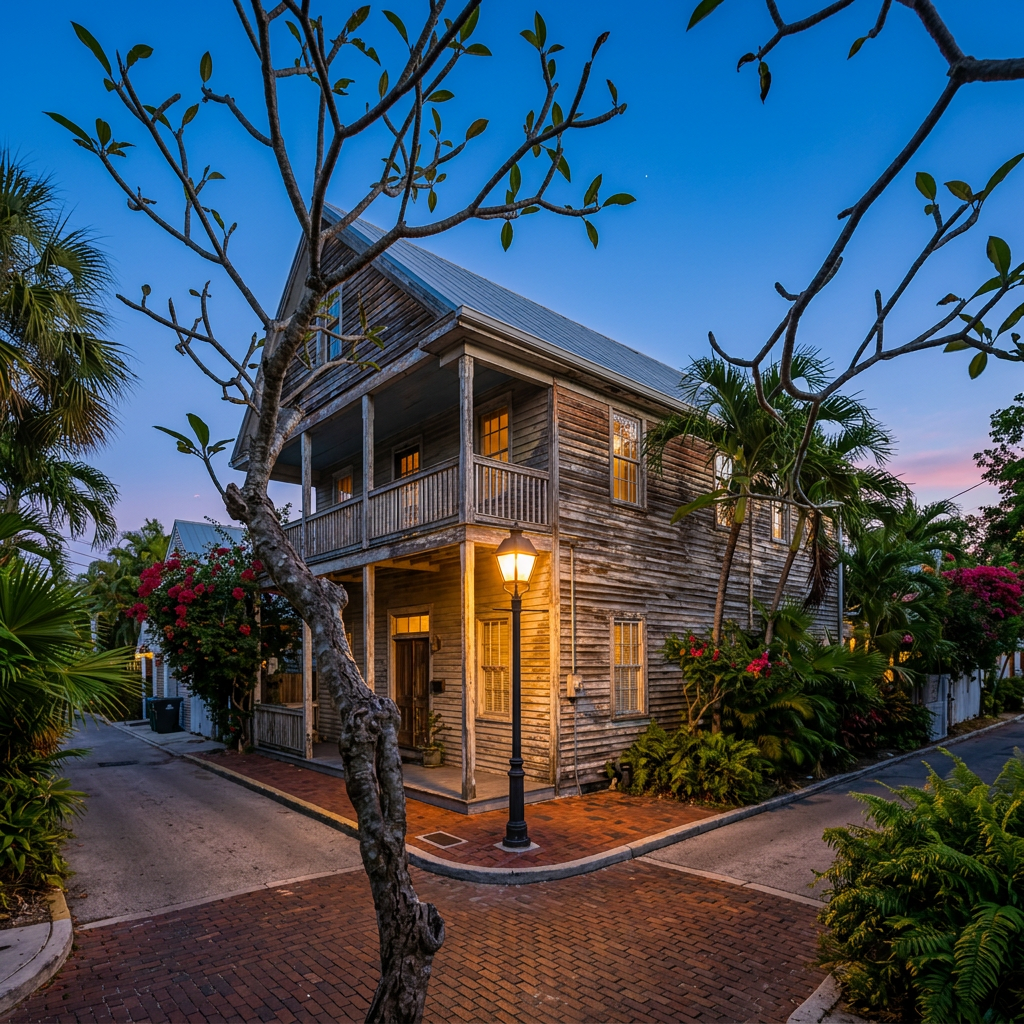
The Weight of Pine and Memory: Protecting Our Architectural Fabric
A Lesson on the Corner of Eaton Street
I was walking past the corner of Eaton and Williams the other day, watching the way the late afternoon light hit the weathered siding of an old eyebrow house. My friend, who serves on the Historic Architectural Review Commission, happened to be walking in the same direction. We stopped, as locals often do, to admire the way the shadows played across the Bahamian shutters. In Key West, these conversations aren't abstract; they are about the tangible, breathing character of the neighborhood. We spend a lot of time talking about the market, but sometimes we forget that the value of our homes is inextricably linked to the fact that they haven't been scrubbed clean by cookie-cutter modernism.
The Stewardship of History
People often ask what HARC actually does. It is easy to view a commission as an obstacle, a stack of forms and a calendar of meetings that slows down a renovation. But when you sit down with a dedicated preservationist, the perspective shifts. It is not about stopping progress, but about ensuring that the changes we make today don't erase the narrative of the previous hundred years. They are protecting the integrity of the Dade County Pine—that dense, termite-resistant heartwood that survived the centuries—and ensuring that when a porch needs repair, it is done with the same joinery techniques used by the shipbuilders who settled this island. It is a form of stewardship, a way of ensuring that the Key West we pass on to the next generation still looks, feels, and breathes like the place that welcomed our grandparents.
Beyond the Facade
There is a misconception that preservation is only about the outward appearance of a property. Yet, the work goes deeper. It is about maintaining the scale of a street, the rhythm of the rooflines, and the materials that defined the island's vernacular architecture. Whether a home is framed in sturdy Dade County Pine or features the later, elegant contributions of cedar and cypress, the commission looks for compatibility. They want to ensure that a new addition doesn't loom over an adjacent cottage, or that a modern roof doesn't clash with the historic tin or wood-shake roofs that characterize our skyline. It is a balancing act. It requires a deep respect for the craftspeople who came before us—the carpenters who didn't have power tools but had a masterful understanding of how to ventilate a room in a climate that demands it.
The Quiet Authority of Old Wood
In my line of work, I see a lot of homes that have been meticulously restored. There is something profoundly satisfying about stepping into a foyer where the original floorboards still creak in exactly the same way they did in 1920. It connects you to the people who walked those boards through storms, celebrations, and quiet Tuesday afternoons. When we choose to renovate with the oversight of a body like HARC, we are essentially making a choice to honor that history. It is a deliberate, often quieter path than a total tear-down or a radical renovation, but it yields something far more substantial. A home that has been lovingly maintained in the context of its historic surroundings holds a value that goes beyond the price per square foot; it holds the weight of our shared island memory.
A Living Fabric
As I watched my friend continue down Eaton, I realized that our architectural heritage is a fragile thing. It survives because people care enough to engage with the process, to sit through the hearings, and to understand that the character of Key West isn't a museum display. It is a living, working environment. We are not just holding onto boards and shingles; we are holding onto a way of life that values the human scale. In a world that increasingly pushes for the shiny and the new, there is a quiet, radical confidence in choosing to preserve the old. It is an investment in the idea that some things are worth keeping exactly as they were meant to be.
Written by
Damian Vantriglia
Realtor® · Key West