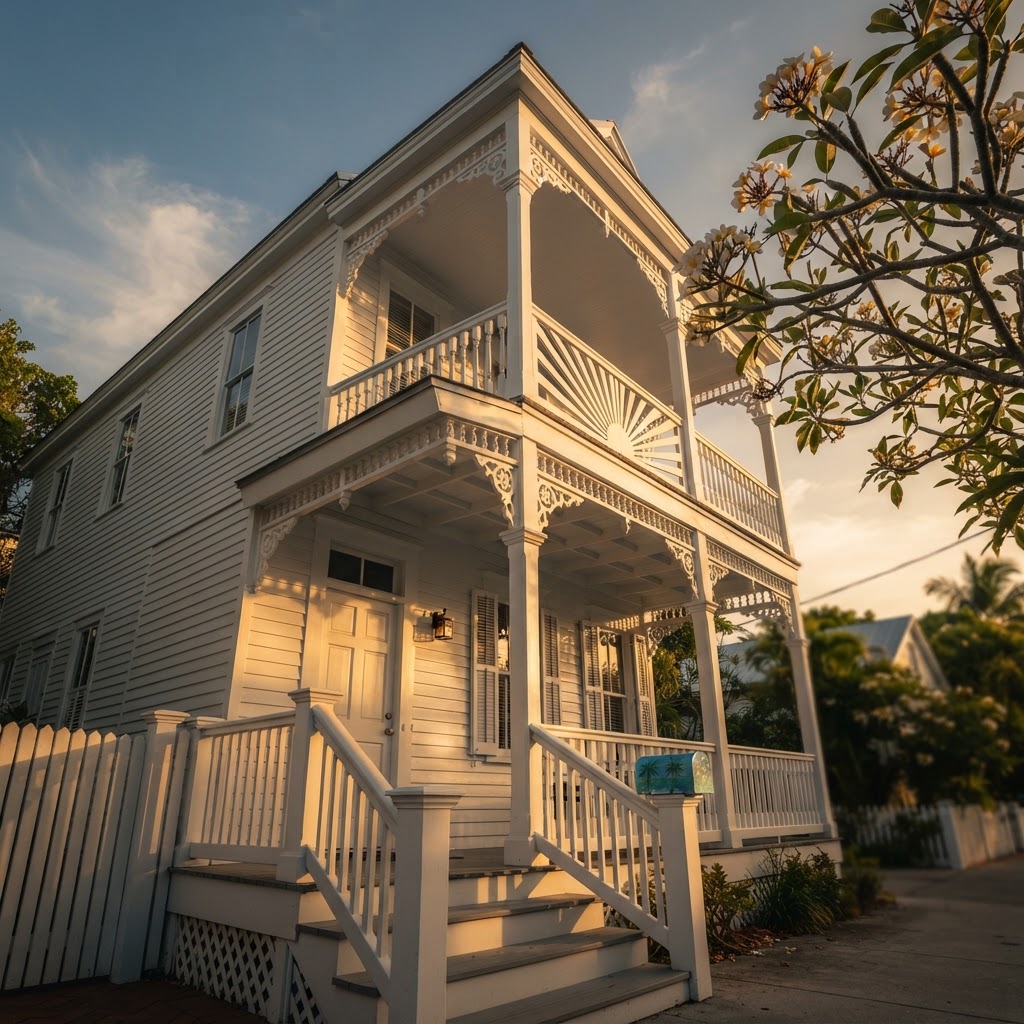
The Weight of History: Understanding the Conch House
The Architecture of Patience
I grew up in a house where the sound of rain on a tin roof was the primary rhythm of the afternoon. There is a specific, hollow resonance to that sound that you simply do not get in modern construction. When I walk clients through a classic conch house in Old Town, I always tell them to pause and listen. You are not just buying a floor plan; you are stepping into a structural philosophy born from the need to survive island storms and tropical heat. These homes, with their elevated piers and deep, louvered shutters, were designed by men who understood that the only way to manage a climate like ours was to work with the wind, not against it.
Most of these homes are framed in Dade County Pine, that dense, sap-rich heartwood that stood up to termites and time when other materials would have simply surrendered. Finding a home with its original structure intact is increasingly rare. Over the decades, we have seen homes renovated with cypress, cedar, and occasionally yellow pine where the original timber could not be salvaged. Each of these woods tells a story of the era in which the repair was made. A house here is a living record of every hand that has touched it, from the original shipwrights who built the frame to the craftspeople who carefully restore the Victorian fretwork today.
The Reality of Stewardship
There is a certain quiet confidence required to own a home that is over a century old. You have to accept that these buildings move. They settle into the coral rock, they expand with the humidity, and they require a level of maintenance that can feel daunting to someone used to the predictability of a newer build. I have never been one to sugarcoat the effort involved. If you are looking for a house that requires nothing but a key in the door, you might be disappointed. But if you value the character of uneven floorboards and the way the light filters through hand-blown glass, then you are in the right place.
For most of the people I work with, the financial reality of these properties is straightforward: cash is king. Because of the nature of historic preservation and the unique risk profiles of our island, securing traditional financing can be an exercise in frustration. Many of the most dedicated owners here treat their property as a long-term asset, often choosing to self-insure or manage risk through deliberate, strategic investments in structural upgrades. It is not a path for everyone, but for those who understand the value of these houses, it is a sound way to ensure that these pieces of our history remain standing for another century.
A Place in the Landscape
Beyond the rafters and the siding, there is the life that happens between these walls. When you buy a house on a street like William or Olivia, you are not buying a private island; you are buying into a community of neighbors who have been watching over one another for generations. You will find yourself knowing the postman’s routine, the way the banyan tree at the corner drops its leaves in late spring, and the specific hour when the heat finally breaks and the neighborhood begins to sit out on the front porches.
I think often of the porches. In the northern states, a porch is a place you sit for a month in the summer. In Key West, the porch is an extension of the living room, a place to gauge the tide and the mood of the street. If you are the kind of person who wants to tuck away from the world, this might not be the house for you. But if you want to be part of the pulse of this place, there is no better vantage point. You will see the neighbors walking their dogs, you will hear the music drifting from the bars, and you will slowly become part of the background, just another layer of history being written into the wood.
Written by
Damian Vantriglia
Realtor® · Key West