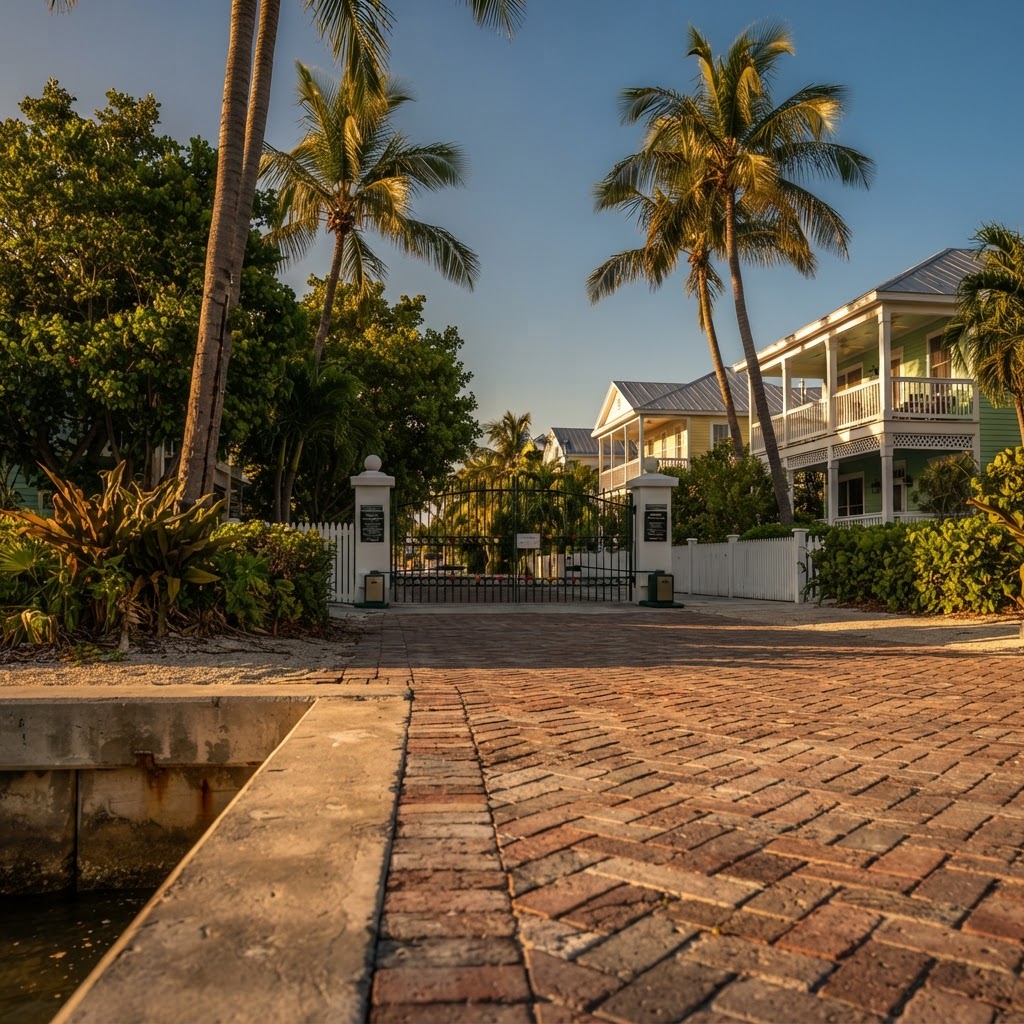
The Quiet Perimeter: Life Inside the Truman Annex
There is a particular stillness that settles over the Truman Annex once the last of the day-trippers have wandered back toward Duval Street. Growing up here, my early memories of this area were defined by chain-link fences and the heavy presence of the United States Navy. It was a place you observed from the outside, a city within a city, guarded and enigmatic. Today, the fences are largely gone, replaced by manicured hedges and a sense of order that feels distinctly different from the chaotic charm of Old Town.
A Geography of Intentional Design
What strikes me most about the Annex is how it manages to feel both private and profoundly connected to the island. When the development took shape in the late 1980s and early 1990s, the planners had a unique challenge: how to respect the historic fabric of Key West while meeting the needs of a new generation of residents. The result is a master-planned neighborhood that mimics the scale and rhythm of our historic conch houses without feeling like a theme park. You see it in the use of wrap-around porches, the generous overhangs, and the careful placement of Bahamian shutters that actually serve a purpose beyond decoration.
The density here is higher than in the wooden bungalows of the Meadows or the quiet lanes near the cemetery, but it is a density that works because it prioritizes the pedestrian. The streets are brick-paved and narrow, forcing drivers to slow down to a pace that matches the humidity. It is common to see residents walking their dogs toward the harbor or heading to the communal pool, and there is a predictable rhythm to the day that appeals to those who want the island experience without the persistent noise of the tourist corridor.
The Materials of Continuity
One of the questions I often get is why the newer homes here feel so authentic. It comes down to material choices. While the original homes in Key West were built with a foundation of dense, rot-resistant Dade County Pine, that timber is a finite resource. In the Annex, architects turned to durable, period-appropriate alternatives like cedar and cypress. These woods age gracefully under the relentless sun, taking on a silvery patina that blends in with the older structures throughout the city.
Walking past a home on Southard Street, you might notice the fine grain of a cypress siding or the way a copper roof has been allowed to weather naturally. These aren't just aesthetic choices; they are nods to the local vernacular. It is a quiet acknowledgment that if you are going to build in a place as significant as Key West, you have an obligation to build for the long haul. The houses here, despite being relatively young by island standards, are holding their own, proving that quality construction transcends the date on the architectural plans.
Privacy as a Lifestyle Choice
There is a segment of the market that values the Annex not because it is showy, but because it is manageable. Many of the buyers I work with are looking for a property that they can secure and step away from without a mountain of maintenance concerns. This is where the trade-off of a homeowner association structure becomes clear. It is not for everyone—some people prefer the total autonomy of owning a single-family historic home on a lot they tend to themselves—but there is a distinct peace of mind found in this corner of the island.
Furthermore, for those who move here with enough capital to manage their own risk, opting for self-insurance becomes a practical way to manage the long-term carrying costs of island property. It is not about ignoring the realities of our environment; it is about taking ownership of them. When you live in a place that has survived hurricanes and shifts in the global economy for centuries, you learn to look at your home as a long-term asset rather than a commodity.
The Harbor Perspective
Ultimately, the soul of the Truman Annex is its proximity to the water. From the western edge, you can look out across the harbor as the sun begins its descent. It is a perspective that feels vast and unburdened. As the sky shifts through the bruised purples and burnt oranges that only happen here, the neighborhood hums with a quiet energy. The boats move slowly toward the sunset, and the distant hum of the island begins to fade. It is a place that encourages you to slow your breathing, to watch the water, and to remember why, of all the places to anchor yourself, you chose this particular rock in the middle of the sea.
Written by
Damian Vantriglia
Realtor® · Key West