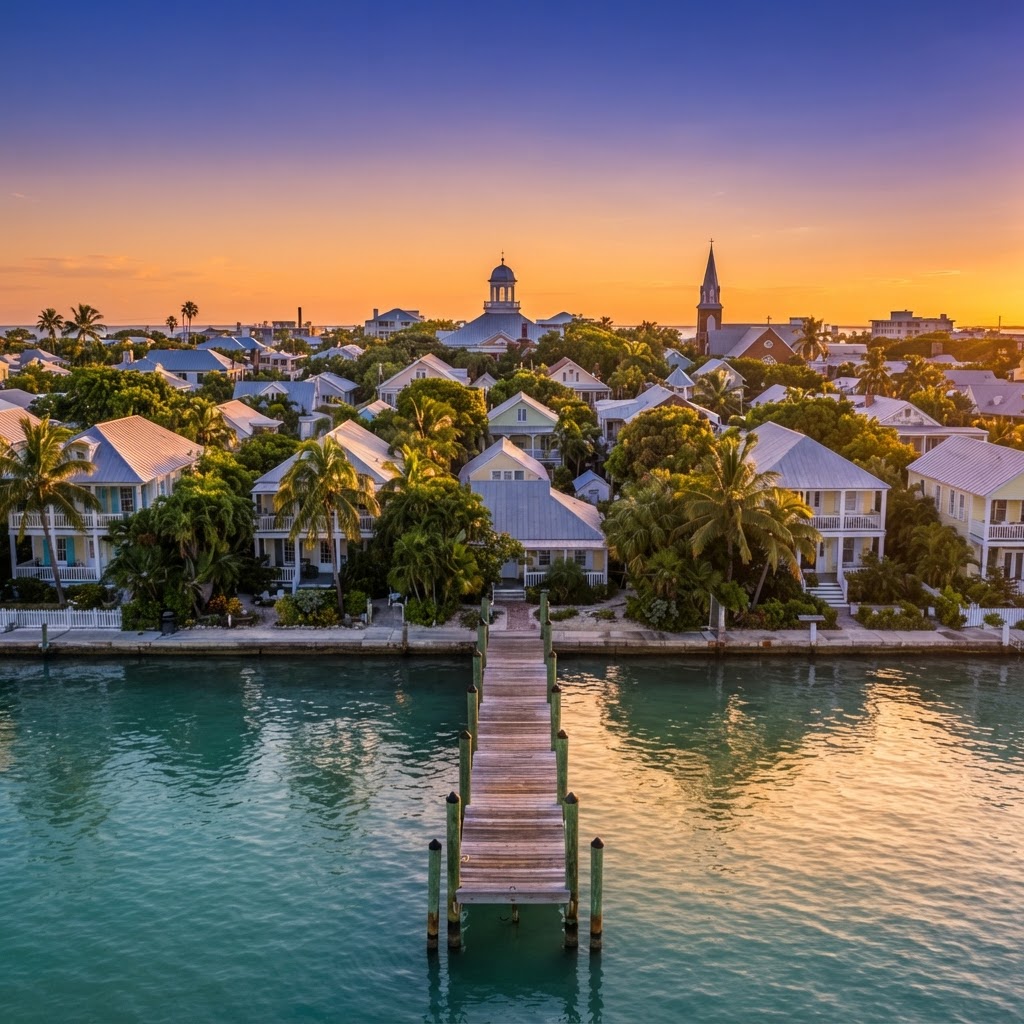
The Great Decoupling: Why Key West Isn't Playing by Mainland Rules
The Island Advantage
I was walking past a familiar porch on William Street yesterday morning, watching the way the light hit the weathered cypress siding. There is a specific stillness to the early hours here before the heat really sets in, a reminder that life in Key West is governed by a rhythm much older than the quarterly market reports that cross my desk. We tend to measure our time in seasons—the flowering of the royal poinciana, the shift in the trade winds—but lately, the conversation among those watching the mainland has shifted toward a more urgent topic: the growing divide in South Florida property values.
A report recently published by the Miami Herald caught my attention. It details a sharp, K-shaped trend across South Florida, where luxury home prices have surged by 14.2% year-over-year while the non-luxury segment has actually seen a slight decline. Miami and West Palm Beach are currently leading the nation in this price disparity, driven by a relentless, high-end appetite for waterfront property that simply cannot be replicated. It is a story of two different economies existing in the same geographic region, and for anyone watching the numbers, it is a clear indicator that the old rules of market correlation are fraying.
The Architecture of Scarcity
When I look at this data, I don't see a cause for alarm. Instead, I see a confirmation of what we have always known about our island. Key West is not just a neighborhood; it is a finite resource. When you talk about the K-shaped divide, you are talking about the scarcity of 'irreplaceable' real estate. On the mainland, there is still land to be cleared, filled, and paved. Here, the boundaries are drawn by the ocean itself. We are physically incapable of sprawl.
Most of our historic homes, framed in the tight, dense grain of Dade County Pine or the durable, salt-resistant cypress and cedar that defined our ancestors' work, are already exactly where they will remain. We are essentially a museum of living, breathing architecture. When you buy a home in the Historic District, you are not buying into a housing development; you are acquiring a piece of a closed loop. Because we cannot build more land, the luxury segment of our market is not just a trend—it is a permanent state of equilibrium that operates independently of the volatility seen in suburban Florida.
A Market Driven by Reality, Not Speculation
There is a perception among some that a market this detached from national averages must be fragile. In my experience, the opposite is true. The strength of the Key West market is found in its independence. Most of the transactions I facilitate are driven by individuals who are looking for a long-term hold, often executed as cash deals. This removes the variable of interest rate sensitivity that plagues the mainland market. When you aren't relying on traditional institutional financing to secure your spot in paradise, the broader economic headwinds simply don't have the same bite.
I also see many of our owners treating risk-management with a level of sophistication that surprises people from up north. For many, self-insuring against property damage is not a reaction to a crisis, but a calculated, deliberate choice. It is a way of acknowledging that owning property in the tropics comes with specific responsibilities, and choosing to manage that capital internally is just part of the cost of admission to this life. It is the confidence of an owner who knows that their asset is not a speculative play, but a legacy piece.
Finding Your Place in the Pattern
Living here requires a bit of humility. You have to be comfortable with the idea that you are a temporary steward of a structure that has likely weathered more storms than the current owner has lived years. When I walk by an eyebrow house on a quiet side street, I am not thinking about its price per square foot. I am thinking about the craftsmen who hand-shaped the trim, the neighbors who have leaned on that same fence for decades, and the simple joy of having a cool porch to sit on while the evening rain hits the tin roof.
The fact that our market has decoupled from the mainland is not a symptom of greed. It is a reflection of the reality that space, history, and proximity to this particular horizon are commodities that only a very small number of people can ever hold at once. If you are looking for an investment that moves in lockstep with the S&P 500, you are looking in the wrong place. But if you are looking for something that carries its own intrinsic value, grounded in the salt air and the history of this island, you are looking exactly where you need to be.
Written by
Damian Vantriglia
Realtor® · Key West