The Art of the Compound and the Quiet Expansion of the Island
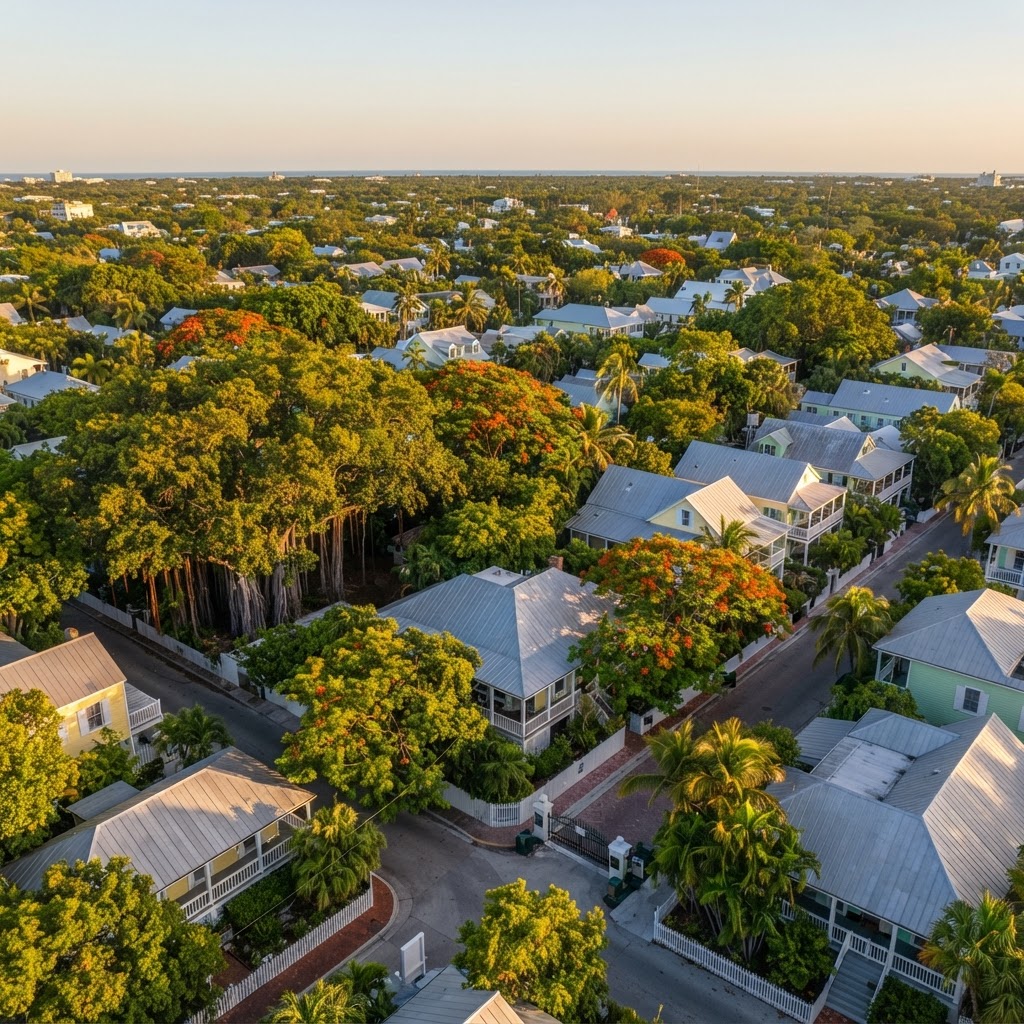
The afternoon light hits the corner of Fleming and William just a little differently this time of year. If you stand there long enough, watching the shadows stretch across the weathered Dade County Pine siding of a nearby eyebrow house, you begin to understand that the true value of a property here isn't just the square footage under roof. It is the context. It is the garden, the privacy, and the quiet continuity of the streetscape. Lately, that appreciation for context has evolved into a distinct trend, one that mirrors what is happening in broader real estate circles across the state, yet feels entirely at home on our narrow lanes.
Is the trend of buying multiple properties for a single compound happening in Key West?
Yes, there is a clear shift among those acquiring property in Key West to consolidate adjacent or nearby lots into private compounds, a trend recently documented by The Real Deal as 'landmaxxing' across the wider South Florida region. As Damian Vantriglia, a born-and-raised Key West REALTOR, I see this daily; buyers who are deeply committed to the island's future are looking past the single residence. They are effectively becoming stewards of their blocks, seeking to secure neighboring parcels to ensure that the integrity of their main estate remains protected from future encroachment.
Why are buyers shifting their focus from single estates to compound ownership?
Buyers are increasingly motivated by the desire to secure legacy assets in an environment where prime inventory is historically constrained. When a buyer identifies a property defined by its authentic character—perhaps one built with original Dade County Pine or featuring rare, mature tropical plantings—the goal is no longer just acquisition. It is preservation. By acquiring an adjacent lot, a buyer creates a buffer, ensuring the peace of their courtyard and the canopy of their Royal Poinciana trees remain untouched. It is a strategic, long-term approach to land ownership that effectively removes those parcels from the speculative cycle, prioritizing the long-term enjoyment of a home over the immediate desire for a turnkey residence.
This movement is not driven by a need for excess, but rather by the reality of our geography. We are an island, and our borders are fixed. When inventory at the high end of the market tightens—which it has, with a noticeable scarcity of refined, well-maintained historic properties—the premium on space and privacy only increases. Those who have been here long enough understand that the houses aren't just buildings; they are part of a living, breathing neighborhood. If you are fortunate enough to own a property that serves as a cornerstone of its street, the current market dynamic offers a rare chance to consolidate your position. Leveraging adjacent land is not about expansion in a commercial sense; it is about securing a legacy.
For many of my clients, this is also where the decision to self-insure comes into play. When you are managing a compound of several historic structures, the approach to risk changes. You are not simply insuring a single roofline; you are managing a portfolio of assets. Many of the most experienced buyers I work with treat this as a deliberate, calculated risk-management strategy, choosing to invest in the quality of the restoration and the long-term structural health of their buildings rather than relying on the complexities of traditional insurance markets. It allows for a level of architectural freedom and long-term stability that is simply not possible under more rigid ownership models.
I often think about the families who built these homes a century ago. They didn't view their houses as investments to be flipped in three years. They viewed them as the center of their lives, and often, their businesses. When a new owner today decides to purchase the house next door to restore it to its original luster, they are continuing that tradition of stewardship. They are honoring the work of the original builders and the craftspeople who keep the island's unique aesthetic alive. It is a quiet, measured way of interacting with the market. Whether it is a classic conch house on a quiet lane or a larger waterfront property facing the Atlantic, the strategy remains the same: treat the home with the respect it deserves, and the home will provide the sanctuary you are seeking. If you find yourself holding a piece of this island with potential for this kind of consolidation, it is worth looking at the board differently. The opportunity to shape the future of your corner of Key West is more present now than it has been in a very long time.
Written by
Damian Vantriglia
Realtor® · Key West