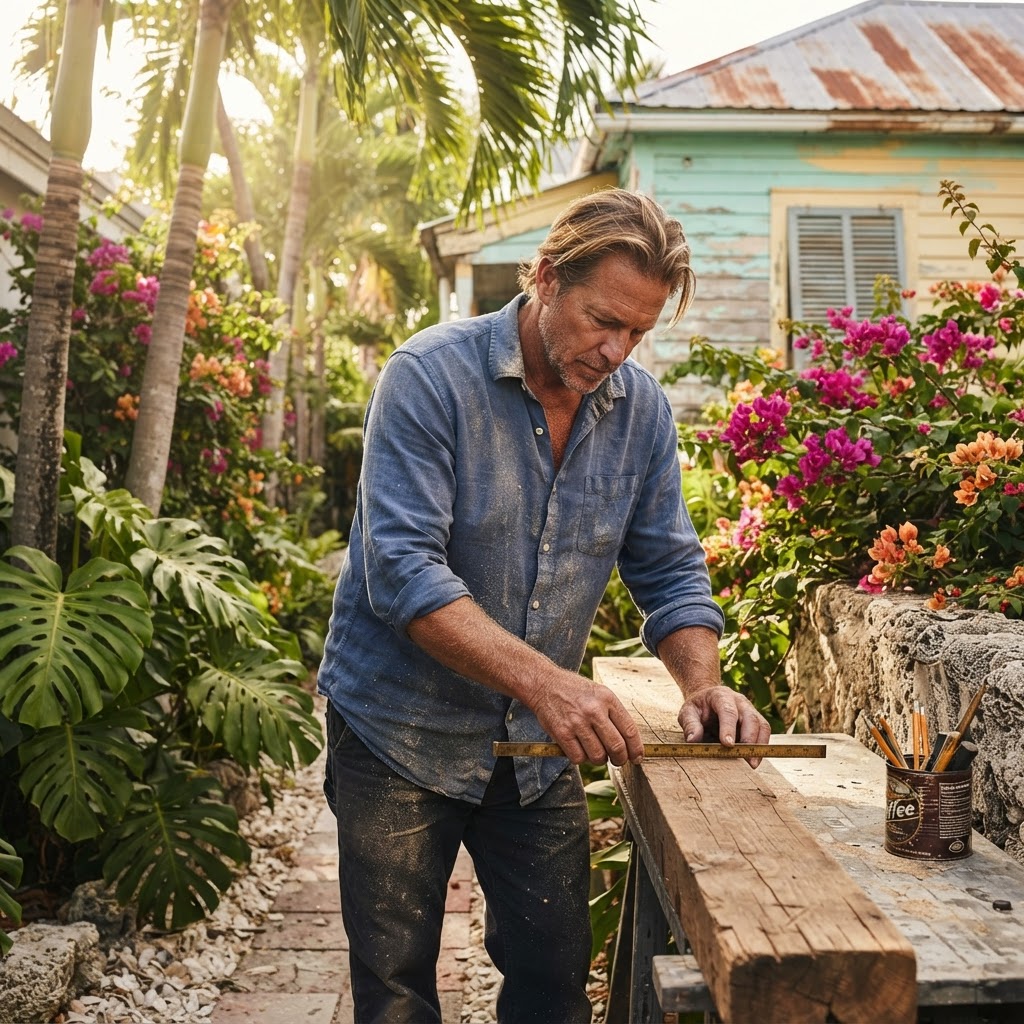
The Architecture of Patience: A Morning with Elias Thorne
The Language of Wood
There is a specific sound to a restoration project in Old Town. It is not the frantic rhythm of a nail gun or the whine of a high-speed saw. It is the rhythmic, deliberate scrape of a hand plane against aged timber. I found Elias Thorne on a quiet stretch of William Street, working on a shotgun-style conch house that had seen better decades. He was knee-deep in sawdust, his hands moving with the kind of muscle memory that only comes from twenty years of listening to what a house needs instead of telling it what it should be.
Elias isn't interested in the modern shortcuts that have started to creep into our historic district. He talks about Dade County pine the way a sommelier talks about a rare vintage. When he pulls a section of original framing out of a wall, he doesn't just see structural decay; he sees the density of a tree that grew slowly, decades before the island was paved over. He insists on replacing damaged sections with matching heart pine or, when the budget requires a compromise, high-grade cedar or cypress that he personally selects from a mill he has trusted since the late nineties. He does not believe in filling gaps with foam or covering history with drywall.
The Stewardship of an Island
It is easy to look at a property listing and see a commodity. I see these houses every day, and I am the first to admit that the market here is demanding. But watching Elias work reminded me that the true value of a Key West home doesn't lie in the finishings or the square footage. It lies in the survival of the structure itself. A house here is a living thing. It breathes with the salt air and shifts with the tropical humidity. If you try to force a house to be something it is not, it will eventually push back.
Elias treats his clients as partners in a long-term conservation effort. He tells them, with that understated, dry humor typical of the island’s best builders, that if they want a house that looks perfect in a catalog, they should probably move to a suburb on the mainland. If they want a house that will be standing for another hundred years, they have to accept that the process involves a fair amount of waiting. You cannot rush the seasoning of wood, and you cannot rush the way a proper Bahamian shutter settles into its frame.
Beyond the Finished Facade
There is a quiet dignity in the way our historic properties age when they are left in the right hands. The pride of ownership in Key West is less about the curb appeal and more about the hidden infrastructure—the way the house stays cool during the peak of July, the way the breeze moves through the center hall, and the way the foundation remains solid despite the relentless salt spray. It is a form of self-insurance, really, investing in the quality of the build so that the building itself can withstand the environment without constant intervention.
As the sun climbed higher over the tin roofs of the neighborhood, I left Elias to his work. I walked toward Duval Street, but found myself lingering on the sidewalks, looking up at the eaves and the pitch of the roofs. We often talk about the market, the price per square foot, and the fluidity of our local economy. But the reality is that the heart of Key West is held together by people like Elias, who move slow enough to get it right. It is a comforting thought, realizing that despite all the changes we see on the island, there is still a small, dedicated circle of people making sure our history remains standing, one hand-planed board at a time.
Written by
Damian Vantriglia
Realtor® · Key West