Stock Island Is Having a Moment: Why Savvy Buyers Are Looking Just East of Key West
For most of Key West's modern history, Stock Island was the island you passed through to get somewhere else. The working waterfront. The boatyards and shrimp docks and commercial fishing operations that kept the Keys economy running while tourists crowded Duval Street a mile to the west.
That perception is changing, and the buyers who recognized the shift early have been rewarded accordingly.
Stock Island is having a moment. Here's why it's happening, what's driving it, and what serious buyers need to understand before the window narrows further.
What Stock Island Actually Is
Stock Island sits immediately east of Key West, connected by bridge, with a Monroe County address rather than a City of Key West address. That distinction matters in ways that are both regulatory and financial.
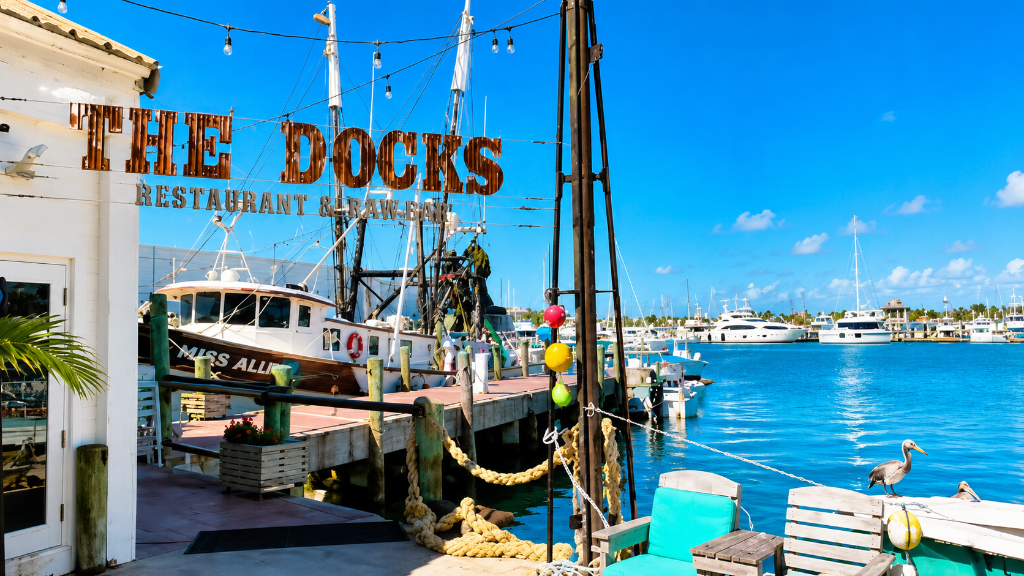
It's home to the Florida Keys Community College, the Perry Hotel (one of the most acclaimed boutique hotels to open in the Keys in the past decade), Stock Island Marina Village (deep-water dockage for serious vessels), a growing collection of artist studios and galleries, and some of the best seafood restaurants in the entire Keys. Places like Hogfish Bar & Grill have been feeding locals for decades and are now drawing food-motivated visitors from the mainland.
The working waterfront character hasn't disappeared. It's been joined by something new: an arts district, a hospitality scene, and a residential market that's attracting buyers who want proximity to Key West without Key West prices or Key West's increasingly stringent regulatory environment.
The Price Differential That Started the Conversation
The fundamental driver of Stock Island's appeal is straightforward. Comparable properties have historically traded at a meaningful discount to Key West, often 20–35% below equivalent Old Town or Mid Town inventory.
For a buyer who wants a waterfront home with a dock, that differential is enormous in absolute dollar terms. A canal-front property with deep-water access that would price at $3.5M+ in Key West proper has historically been acquirable on Stock Island for $2.2–$2.8M. That spread has compressed in recent years, which is itself a signal, but it has not disappeared.
For investment-focused buyers, the calculus includes rental income potential. Stock Island properties are subject to Monroe County regulations rather than City of Key West regulations, which have historically offered more flexibility on vacation rental licensing. This is a nuanced area that warrants specific legal and regulatory due diligence, but it's a factor that sophisticated investment buyers consistently cite.
What's Driving the Moment
The Perry Hotel Effect. The opening of the Perry Hotel & Marina changed the narrative around Stock Island in a concrete, visible way. A project of that caliber, thoughtfully designed, nationally reviewed, and attracting a clientele that previously wouldn't have considered the address, signals to buyers that institutional money has done its own due diligence on the neighborhood's trajectory. That signal matters.
The Arts District. The Studios of Key West, artist residencies, gallery spaces, and creative businesses have been steadily migrating to Stock Island as Key West proper has become less financially accessible to working artists. What follows artists is a pattern that urban real estate observers know well: the neighborhood gets interesting, then it gets discovered, then it gets expensive. Stock Island is somewhere in the middle of that arc.
Marina Infrastructure. Stock Island Marina Village and Oceanside Marina offer deep-water dockage for vessels that can't navigate the shallower waters of many Key West marinas. For serious boaters who own 50+ foot vessels, this is not a minor amenity. It's a primary driver of property selection, and it makes Stock Island waterfront properties genuinely superior to some Key West alternatives.
Infrastructure Investment. Monroe County has been investing in Stock Island's infrastructure in ways that signal a long-term commitment to the area's development. Road improvements, utility upgrades, and planning decisions that support mixed-use development all point in the same direction.
What to Buy and Where to Look
Not all of Stock Island is equal, and the neighborhood still has pockets that are several years behind the leading edge of appreciation. Here's how I think about the opportunity:
Waterfront with dock access is the strongest long-term hold. Canal-front and harbor-front properties with functional dockage have the clearest demand story. Boaters who want Key West proximity will pay for it, and the supply of deep-water dockage in the Florida Keys is genuinely constrained.
Properties near the Perry Hotel corridor have the clearest near-term appreciation thesis. The concentration of hospitality, dining, and marina amenities in this zone creates a walkable, amenity-rich environment that commands a premium over Stock Island's more residential edges.
Residential properties with rental history offer the most defensible investment case. Documented rental income, particularly from a property that has operated legally under Monroe County's licensing framework, is the strongest foundation for an investment acquisition.
What to approach with caution: Properties with significant deferred maintenance in areas away from the marina district may be value plays. But Stock Island, like all of the Keys, has specific environmental and structural considerations, including flood zone designations, wind mitigation requirements, and septic-to-sewer conversion mandates, that require thorough due diligence before committing.
The Regulatory Landscape
One of the most important distinctions between Stock Island and Key West proper is regulatory. Stock Island falls under Monroe County jurisdiction, which means different rules for building permits, vacation rentals, and land use.
Monroe County has its own set of ROGO (Rate of Growth Ordinance) allocations that govern new construction. The county's vacation rental regulations differ from the City of Key West's and have in some respects been more permissive, though this is an area of active regulatory evolution that buyers should verify at the time of any acquisition.
Flood zone designations on Stock Island require careful review property by property. Many properties fall in AE or VE flood zones with corresponding insurance cost implications. A thorough insurance cost analysis, covering flood, wind, and homeowner's coverage, should be part of any offer decision, not an afterthought.
The Window Is Narrowing, Not Closed
The buyers who moved on Stock Island five years ago made an excellent decision. The buyers who move today are still entering before the full repricing that the neighborhood's trajectory suggests is coming, but the window is narrower than it was.
The price differential to Key West proper has compressed. The Perry Hotel and the marina district have already been discovered. The arts scene is established. What hasn't fully repriced yet is the broader residential fabric away from the highest-profile anchors: the mid-block waterfront homes, the properties that need updating, the opportunities that require vision rather than just a checkbook.
For buyers willing to do the work, the due diligence, the renovation, the patience to hold through the next phase of the neighborhood's evolution, Stock Island still offers a compelling entry point into a market that is fundamentally adjacent to one of the most supply-constrained luxury real estate markets in the United States.
What I Tell Buyers Who Ask About Stock Island
I tell them the truth: it's not Key West. The streets are wider and less charming. The tourist infrastructure isn't there. If you want to walk to Duval Street for dinner, this isn't your address.
But if you want deep-water dockage, proximity to everything Key West offers, a price point that still makes sense, and a neighborhood that is visibly and measurably improving, Stock Island deserves a serious look.
The buyers who came to Key West in the 1980s and 1990s, when Old Town was undervalued and under-discovered, made generational wealth decisions. Stock Island is not that opportunity; that ship has partly sailed. But it rhymes with it. And in a market as supply-constrained as the Florida Keys, rhymes are worth paying attention to.
Damian Vantriglia is a Key West native and REALTOR® with extensive experience in both Key West and Stock Island residential and investment properties. If you're evaluating the Stock Island market, he's happy to walk you through the current inventory and opportunity set.
Written by
Damian Vantriglia
Realtor® · Key West