A Rarefied Shoreline: Institutional Moves in the Upper Keys
The Calculus of Scarcity
There is a certain rhythm to the way things shift in our islands. Often, the most significant changes happen with a quietude that belies their importance. We see a new coat of paint on a conch house on William Street or notice a banyan tree finally being pruned back after a long season, and we assume the pace of life is simply continuing as it always has. But beneath that steady surface, the mechanics of our market are often being appraised by those who look at the horizon with a very long view.
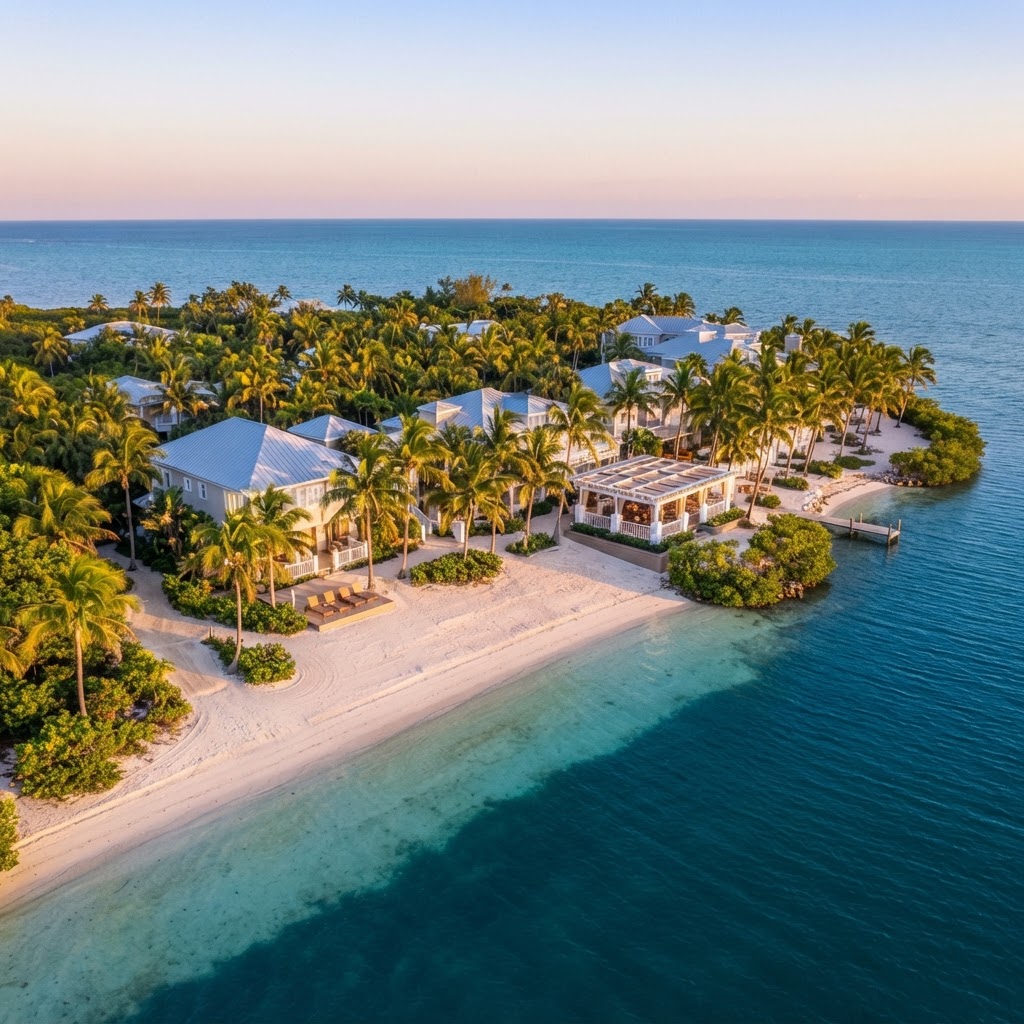
Recently, The Real Deal reported that Mast Capital and Koch Real Estate Investments have reacquired the Islands of Islamorada resort for $38.4 million. It is a notable headline, certainly, but for those of us who have spent our lives watching the landscape of the Keys, the implications are more interesting than the dollar amount. When groups of this caliber commit significant capital to a project involving twenty-two waterfront villas, they are not speculating on a quick turn. They are making a statement about the nature of our geography.
The Keys as a Finite Asset Class
In my work, I often talk about the inherent constraints of our home. We are a chain of islands defined by the water that surrounds us and, perhaps more importantly, by the limited land available to house us. In mainland Florida, development is often a matter of moving further outward—pushing into the marsh or the scrub until the landscape is indistinguishable from the county line over. Here, we don't have that luxury. Every parcel of land that can hold a structure is already spoken for, and the barriers to adding more are immense.
This is why institutional interest in the Florida Keys is so telling. Large-scale investors are not merely buying buildings; they are buying into a finite asset class. By concentrating their efforts here, they are recognizing that the supply of developable waterfront property in the Keys is effectively fixed. For the local owner, this provides a kind of structural stability. When the institutions signal that they value this permanence, it acts as a silent endorsement of the region’s long-term resilience against the sharper, more erratic price swings that often characterize the more saturated markets on the mainland.
Perspective from the Porch
It is easy to get caught up in the optics of a multi-million dollar transaction, but I find it more useful to think about what this means for the integrity of our neighborhoods. Whether you are living in a historic home framed with heavy, seasoned Dade County Pine or settling into a newer build that respects the architectural vernacular of our history, you are participating in a market that remains stubbornly anchored to the character of the place.
We see these institutional moves as a vote of confidence in the Keys' maturity. It reinforces the reality that, despite the inevitable pressures of time and growth, this collection of islands remains a distinct environment. It is not just about the villas or the resort amenities; it is about the fact that the Keys have retained their value because they have retained their identity. We are not a suburb of somewhere else. We are a specific destination with a physical limit to our growth, and that constraint is exactly what protects the value of what we have built.
When I look at the news of this acquisition, I do not see a harbinger of change that will upend our way of life. Instead, I see a confirmation of something we have known for generations: that the land beneath our feet is a precious, non-renewable resource. As long as we continue to steward it with the same care we give to our historic properties and our gardens, the strength of our market will take care of itself. It is a quiet, steady reality, much like the sun setting over the Gulf—predictable, enduring, and remarkably consistent.
Written by
Damian Vantriglia
Realtor® · Key West