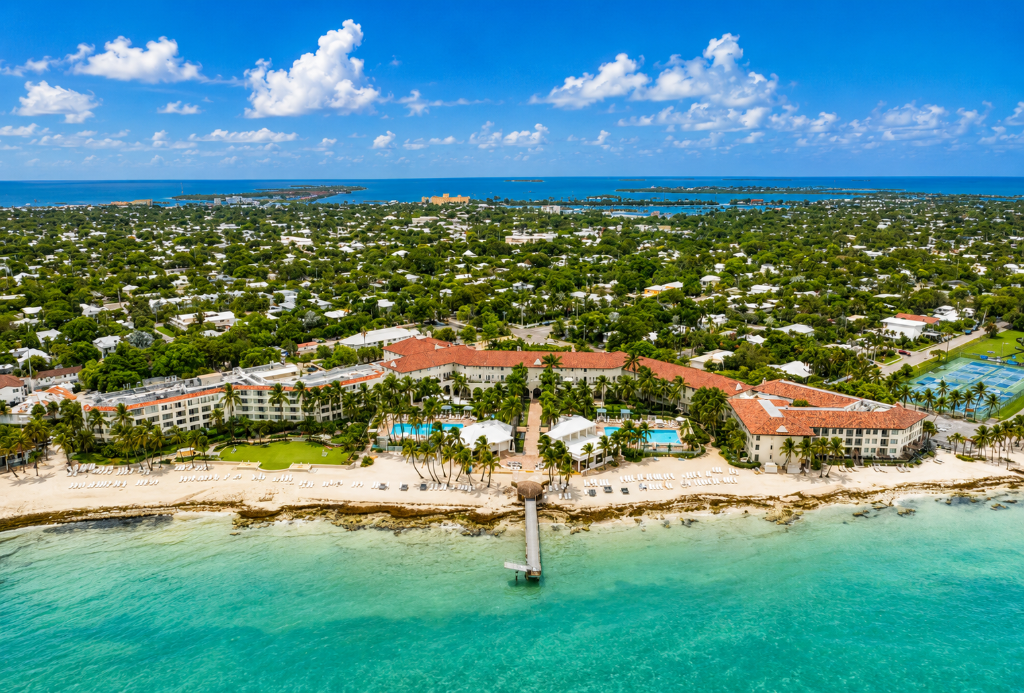
Casa Marina and the Architects of the New York Public Library
I've stood on the Casa Marina's oceanfront loggia a hundred times, and I still can't quite believe it's here.
Not because Key West doesn't deserve a grand hotel. It does. But because the story of how this building came to sit on the Atlantic, at the very end of the continent, is so unlikely that it reads like a bet someone made and then, against every reasonable expectation, won.
The bet belonged to Henry Flagler.
The Railroad That Built the Hotel
Flagler was the railroad man. Standard Oil money, then Florida, then steel rail pushing south through swamps nobody wanted, over water nobody had bridged, until 1912 when the first train rolled into Key West on the Overseas Railroad: 156 miles of track and 42 bridges across open ocean. Key West, an island of fishermen and spongers and cigar rollers, became the end of the American line. Flagler was eighty-two when the first train arrived. He came down off his private car, looked at the crowd, and wept. He died the next year.
But before he died he had promised the town a grand hotel, a real one, a destination, to give the railroad a reason to exist once the novelty of trains-in-the-sea wore off. He didn't live to see it built. The men who carried the project forward broke ground in 1918, and to design the thing they reached for the most serious architects in the country: Carrère and Hastings.
The Men Who Built the Library
If you don't know the names, you know their work. John Carrère and Thomas Hastings designed the New York Public Library, the one on 42nd Street with the stone lions out front, the one that turned a city's reading room into a marble temple. They designed the House and Senate office buildings in Washington. They designed the old Metropolitan Opera House. They were Beaux-Arts men, trained in Paris, and they built with the conviction that a building should look like it intended to last a thousand years.
That they turned up at the end of a railroad in the Florida Keys to build a hotel says something about what Key West was, and what Flagler's project meant, in the years before everything changed. This was not a beach resort thrown up to catch a season. It was a monument: to a man, to a railroad, to the idea that the island at the end of the line deserved the same architectural seriousness as a library on Fifth Avenue.
Casa Marina opened on New Year's Eve, 1920. Spanish Renaissance, stucco walls the color of old bone, red tile roofs, arched loggias facing the sea. Three days later, President Warren G. Harding came down to play golf and stand on the beach, and the hotel's reputation as a serious address was settled before the first season was over.
What Survived
The railroad didn't last. The 1935 Labor Day hurricane took out the tracks across the Middle Keys, and the Overseas Railroad never ran again. The hotel that was built to serve it kept going anyway. The Navy took it over during the Second World War for officer's quarters. In the 1950s it came back as a destination: Gregory Peck, Rita Hayworth, Tennessee Williams spent seasons here. During the Cuban Missile Crisis the Army parked a Hawk missile battalion on the grounds, ninety miles from Havana, and the grand loggia looked out over sandbagged emplacements instead of bathing suits.
There have been renovations since, good ones and bad ones, and the property has worn half a dozen flags over the years. But the bones held. The proportions held. You can still stand in the central courtyard and feel the logic of the original plan, the way the building opens to the ocean, the way the loggias carry the breeze, the way a Beaux-Arts architect trained on libraries and opera houses thought about how people ought to move through a space even at the end of the earth.
I think about that a lot. That a building this considered sits here, on this island, because a railroad man believed Key West was worth the best he could commission. He was right, and he never saw it.
The Casa Marina isn't a listing. I'm not selling it. I'm just telling you that this is the kind of place you live near when you live in Key West, and that the architectural inheritance of the island runs deeper than most people know. When someone asks me what's special about owning property down here, beyond the water, beyond the light, this is part of the answer. You're buying into a place that was taken seriously, a hundred years ago, by people who could have built anywhere.
Written by
Damian Vantriglia
Realtor® · Key West