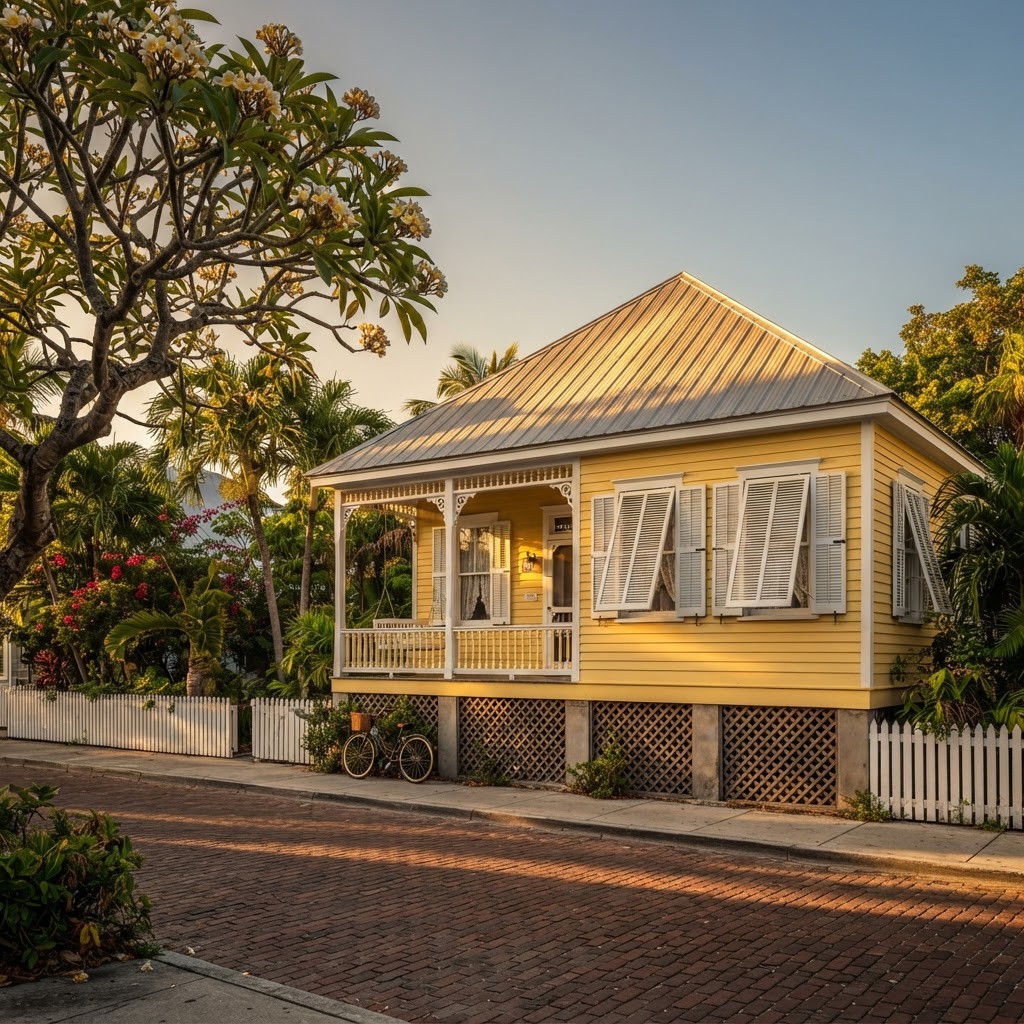
The Architecture of Old Town: Reading the Story in the Wood
There is a rhythm to walking down a lane in Old Town that you don't find anywhere else. It isn't just the light filtering through the canopy of a royal poinciana or the way the sea air carries the scent of salt and jasmine. It is the architecture itself. When I walk past a house on Fleming or Petronia, I don't just see a façade; I see a structural history of how we adapted to this island. As a born-and-raised Key West resident, I have spent my life observing these buildings, and I have learned that the best way to understand an Old Town home is to stop looking at it as a commodity and start seeing it as an organism that has evolved over a century.
What defines the classic Bahamian-Conch style?
The defining elements of a classic Key West Conch house are its elevated pier construction, steep pitched roof, and the strategic use of louvered shutters to manage light and airflow. These homes were designed by shipbuilders who translated their nautical craft into land-based architecture. The elevation serves two purposes: it protects the floor joists from the damp ground and allows air to circulate underneath, keeping the interior cooler in the humid months. These houses were never meant to be sealed off; they were built to breathe.
Why is Dade County Pine the heart of these homes?
Dade County Pine, a dense, heart-pine variety characterized by its high resin content and termite resistance, is the defining timber of our historic housing stock. When you step into a home that retains its original flooring or wall cladding, you are walking on wood that is virtually indestructible. Because this timber became increasingly scarce, many of our historic structures were later framed or repaired with cypress, cedar, or yellow pine. A well-maintained historic home in Key West often features a combination of these woods, and each species carries its own narrative. I always tell my clients that if a house has its original Dade County Pine still intact, you aren't just buying a floor; you are buying the very bones of the island's history.
How does historic preservation affect current ownership?
Owning a piece of history in Key West requires a respect for HARC, or the Historic Architectural Review Commission, which oversees exterior changes to properties within the city's designated historic districts. If you are looking at a property in Old Town, you should view these guidelines not as a hurdle, but as a framework for protecting the long-term value of your investment. Because the city is geographically finite, the inventory of true historic homes will never grow. This is why careful, thoughtful renovation is so prized here. Whether it is restoring the integrity of an eyebrow house or ensuring that a new addition complements the scale of the surrounding neighborhood, the goal is to balance modern living requirements with the preservation of the original architectural character.
Living here means embracing the quirks of these old structures. It is the sound of a tin roof in a rain shower and the way the morning sun hits the louvers on your porch. It is the realization that these homes were built by people who understood the sea, the heat, and the quiet pace of island life. When you decide to own one, you aren't just acquiring a deed; you are becoming the next temporary custodian of a very enduring story.
Written by
Damian Vantriglia
Realtor® · Key West