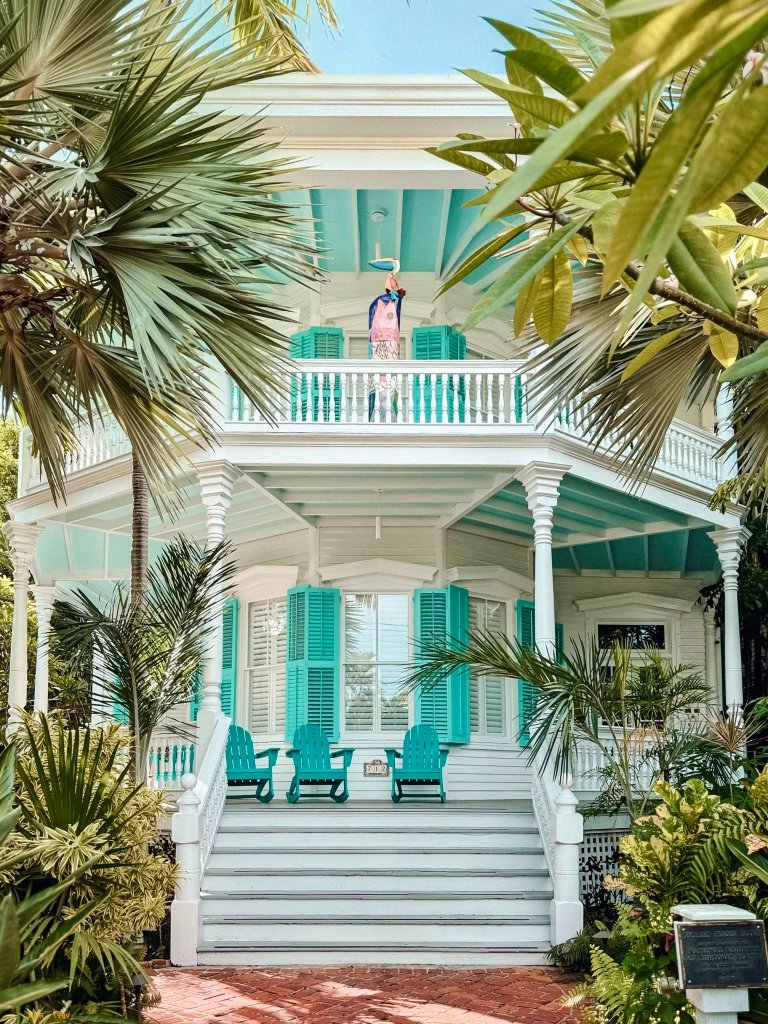
712 Eaton Street: The House That Helped Define Modern Key West
Some homes are beautiful.
Some are historic.
A rare few become part of the story of a city.
Tucked quietly beneath the canopy of Old Town sits one of Key West's most remarkable residences — a home whose walls have witnessed nearly 140 years of island history while helping shape the way the world sees Key West today.
Welcome to 712 Eaton Street, better known as The Octagon House.
A House Unlike Any Other
Even in a town celebrated for architectural individuality, the Octagon House stands apart.
It is one of only two surviving octagon houses in Key West and is believed to be the southernmost octagonal residence in the continental United States. Rather than the traditional rectangular footprint found throughout Old Town, its distinctive bow-front design creates rooms filled with natural light and gentle curves that feel remarkably contemporary despite dating to the nineteenth century.
Locals have long referred to this style as a "bow front" house, but its geometry offers something that conventional architecture simply cannot. The octagonal living room naturally draws people together, while oversized windows invite sunlight from multiple angles throughout the day. It is elegant without trying to be.
More than a century before "open concept" became a marketing buzzword, this house already understood how spaces should flow.
Built During Key West's Golden Age
Around 1885, Richard Peacon commissioned the home.
Peacon was one of the island's most successful merchants, operating one of Key West's premier grocery businesses at 800 Fleming Street before becoming a founding director of Island City National Bank.
Like many influential families of the era, the Peacons were part of the Bahamian Conch community whose craftsmanship and entrepreneurship helped transform Key West into one of the wealthiest cities in Florida during the late nineteenth century.
Remarkably, the home remained in the Peacon family for nearly ninety years.
While countless historic houses changed hands through generations, 712 Eaton quietly preserved its character, waiting for someone who could recognize what it might become.
The Restoration That Changed Everything
That person arrived in the mid-1970s.
Internationally renowned interior designer Angelo Donghia discovered the aging house at a time when much of Old Town remained overlooked by the wider design world.
Where others saw a tired Victorian home, Donghia saw possibility.
He purchased the property for just $45,000 and spent the next two years carefully restoring it alongside architect Fred Cole.
The result wasn't simply another renovation.
It became one of the defining preservation projects of modern Key West.
Published in Architectural Digest, the home introduced readers around the country to a different vision of island living — one built on simplicity, craftsmanship, natural light, and understated elegance.
Donghia resisted excess.
White-painted wood. Bleached floors. Canvas upholstery. Natural rattan.
His design philosophy embraced the architecture rather than competing with it, creating an aesthetic that still feels fresh nearly fifty years later.
Today, many of the design principles associated with sophisticated coastal interiors can trace part of their lineage back to projects like this one.
Before Fashion Found Key West
Because Calvin Klein later purchased the property, many casually refer to 712 Eaton Street as "Calvin Klein's House."
But that overlooks the home's most important chapter.
By the time Klein arrived in 1981, the transformation had already happened.
Donghia had elevated the residence into one of America's most celebrated restoration projects.
Klein's purchase — reportedly for a then-astonishing $975,000 — wasn't what made the house famous.
It confirmed that Key West had become a destination worthy of the world's most influential designers, artists, and tastemakers.
The sale sent a message far beyond the island.
Historic Key West wasn't merely a charming fishing town anymore.
It had become an international design destination.
Timeless by Design
Walk through the home today and remarkably little feels dated.
The upstairs octagonal primary suite remains one of the most memorable spaces in Key West residential architecture. The wraparound verandas continue to blur the line between indoors and outdoors. The tropical gardens provide privacy while reinforcing the relaxed elegance that has always defined the property.
It's rare for a house to feel both deeply historic and effortlessly current.
The Octagon House manages both.
More Than a Landmark
In a city filled with remarkable architecture, 712 Eaton Street occupies a category all its own.
It tells the story of Bahamian craftsmen who helped build Old Town. It reflects the preservation movement that saved countless historic homes. It represents the moment when internationally recognized designers began to see Key West as more than a vacation destination.
And perhaps most importantly, it reminds us that the best homes don't simply survive history.
They help create it.
As a lifelong Key Wester, I've always believed our most significant properties deserve to be understood — not simply admired. Every historic home has a story, but a select few become woven into the identity of the island itself. The Octagon House is one of them.
Damian Vantriglia is a Key West native and REALTOR® specializing in historic and luxury residential properties throughout the Florida Keys.
Written by
Damian Vantriglia
Realtor® · Key West